As the outflow of young people from regional areas becomes increasingly structural, a lack of information about local industries and job opportunities has been identified as another key contributing factor. While the trend of young people relocating to the Seoul metropolitan area in search of better jobs and opportunities has long been ongoing, growing concern stems from the fact that many are leaving without a sufficient understanding of the local industrial landscape. Some observers point out that the perception that "there are no jobs" may not accurately reflect the actual industrial structure.
In reality, a wide range of companies — from traditional manufacturing to advanced industries — are established in the region, yet young people have limited opportunities to
experience this firsthand. Employment information also tends to circulate primarily around the metropolitan area, making local companies less accessible. As a result, a
recurring mismatch has become entrenched, where local companies struggle with labor shortages while young people cannot find work.
To address this issue, Daegu Ilbo launched 'Bulyeoilgyeon (不如一見),' a hands-on company visit program. True to its meaning — "one look is worth a hundred words" — the program aims to help young people clarify their career paths through the experience of directly seeing and feeling what industry looks like on the ground. What sets it apart from existing
employment programs is its focus on experience and dialogue rather than mere information delivery.
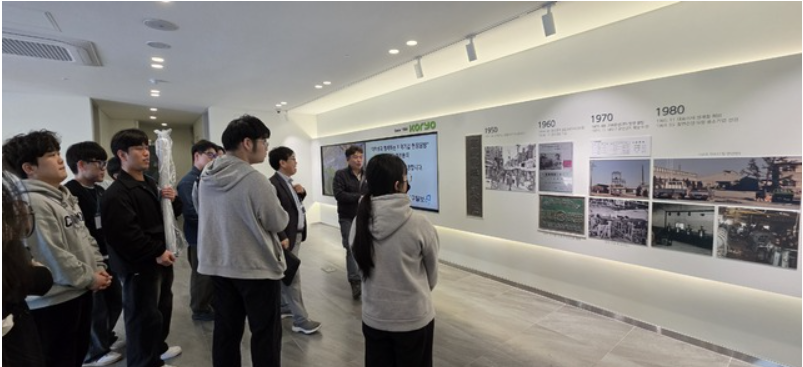
The first visit took place on the 20th at KORYO CABLE, a wire and cable manufacturer located in Dalseo-gu, Daegu. KORYO CABLE is a leading regional power infrastructure
company that has produced high-voltage power cables, insulated wires, and overhead transmission lines for over 60 years. Building on a stable domestic foundation, the company
has recently been expanding into overseas markets and strengthening its global competitiveness.
Seventeen university students from the Social Heritage Club (SHC) and the big data and AI club 'Gyeolchobo-eun' participated in the visit. After receiving a company overview
covering its history, key businesses, and technological capabilities, participants toured the actual production lines.
Inside the factory, thick power cables were continuously being wound, and the entire process — from raw material input through multiple stages to finished product — unfolded before their eyes. The seamless connection between each stage, including conductor processing, insulation treatment, and outer sheath coating, gave students a vivid picture of how a
single product comes to life. The dynamism of an industrial site was on full display.
In particular, witnessing the production of high-voltage power cables and insulated wires provided an opportunity to verify in practice what students had only encountered in theory. Some students asked detailed questions about the role of each process and the technical differences involved, showing a high level of interest. Many reported that their overall understanding of the industry had significantly deepened through the hands-on experience.
Prior to the visit, KORYO CABLE CEO Jung Yong-ho expressed his welcome: "I'm grateful to the students who took the time to visit us. I hope this experience goes beyond a simple
field trip and serves as practical guidance as you think about your careers." He added, "Local companies are also creating diverse opportunities through overseas expansion and
technological innovation, and I hope you'll look at us with a broader perspective."
Students who experienced the site spoke highly of the program's effectiveness, saying it helped them move from vague uncertainty about their careers to a more concrete sense of
direction.
Choi Jeong-in (22, female) said, "I joined because I was curious about how my major in management information systems could be applied in a real company. Seeing the production structure and operational methods firsthand helped me map out my career direction much more specifically."
Hwang Jeong-min (23, female) shared a similar sentiment: "My major doesn't directly align, but I joined out of curiosity about the industry itself. Watching the entire process of how a product is made completely changed my perception of local companies." She added, "Being able to connect what I learned in theory to what I saw in the field made it a very
meaningful experience."
Professor Lee Chung-kwon of Keimyung University's Department of Management Information Systems, who participated as a faculty advisor, emphasized the program's educational value: "It is significant that students were able to broaden their understanding of local industries and job opportunities while also exploring actual employment prospects. Hands-on experiences like this can help close the information gap between local talent and companies, and ultimately contribute to resolving the mismatch."
The 'See It for Yourself' program distinguishes itself by combining Q&A sessions with company executives and direct production floor experience, going beyond a simple facility tour. This allows students to gain a more realistic understanding of company culture and work environments, while companies can directly communicate their strengths to potential
future talent.
The program is also expected to contribute to improving perceptions of the regional industry as a whole — moving away from an image centered solely on manufacturing, and
offering participants the chance to experience an evolving industrial structure that embraces technological innovation and global market expansion.
The program is systematically designed to run with 15 to 30 students per session, targeting university students in the Daegu–Gyeongbuk region. During the semester, visits focus on
companies in Daegu; during vacation periods, the focus shifts to companies in Gyeongbuk. Students are selected through advance applications, and the program is open to
participants from diverse academic backgrounds regardless of major.
The scope of future visits is also set to expand — beyond traditional manufacturing to cover smart factories, AI data centers, advanced robotics, and sensor industries, giving young
people access to a broader range of career options.
Locally, there is keen interest in whether this initiative can serve as a starting point for addressing youth outflow. While it is difficult to reverse migration patterns in the short term,
the prevailing view is that it is meaningful at minimum to reduce choices made simply due to a lack of information.
Experts note that the issue of youth outflow should not be viewed solely as a matter of the number of available jobs, but also addressed from the perspective of information
accessibility and perception change. When information about the competitiveness and growth potential of local companies is not adequately communicated, young people are more likely to gravitate toward the more familiar metropolitan area.
In this respect, hands-on programs like 'See It for Yourself' can play a role in giving young people a realistic basis for decision-making — enabling career choices grounded in concrete information rather than vague impressions, through the process of seeing, asking, and experiencing firsthand.
Daegu Ilbo President Lee Hu-hyeok stated: "We determined that providing young people with opportunities to properly understand the local industry is of paramount importance.
Going forward, we plan to expand the program in collaboration with a wider range of companies and strengthen our role as a platform connecting local talent with local businesses."
The 'See It for Yourself' program began in a reality where opportunities to truly experience local industry had been scarce. All eyes are now on what changes it will bring to the
choices young people make — and what ripple effects it will have on the regional industrial ecosystem.
Reporter Kwon Young-jin | b0127kyj@idaegu.com